Rapid HIV Test (HIV Ab): Results in Less Than 30 Minutes
If you are looking for a Rapid HIV Test, you probably have important questions before getting tested. How accurate is the test? When is the right time to take it after possible exposure? Can the test be done at home? And what does a positive or negative result actually mean?
At Al Safa Medical Laboratory, we provide the Rapid HIV Antibody Test (HIV Ab) with results available in less than 30 minutes. We also ensure complete confidentiality, professional laboratory standards, and the option of home blood sample collection for your convenience.
Book your Rapid HIV Test today or request a home sample collection service.
What Is the Rapid HIV Test?
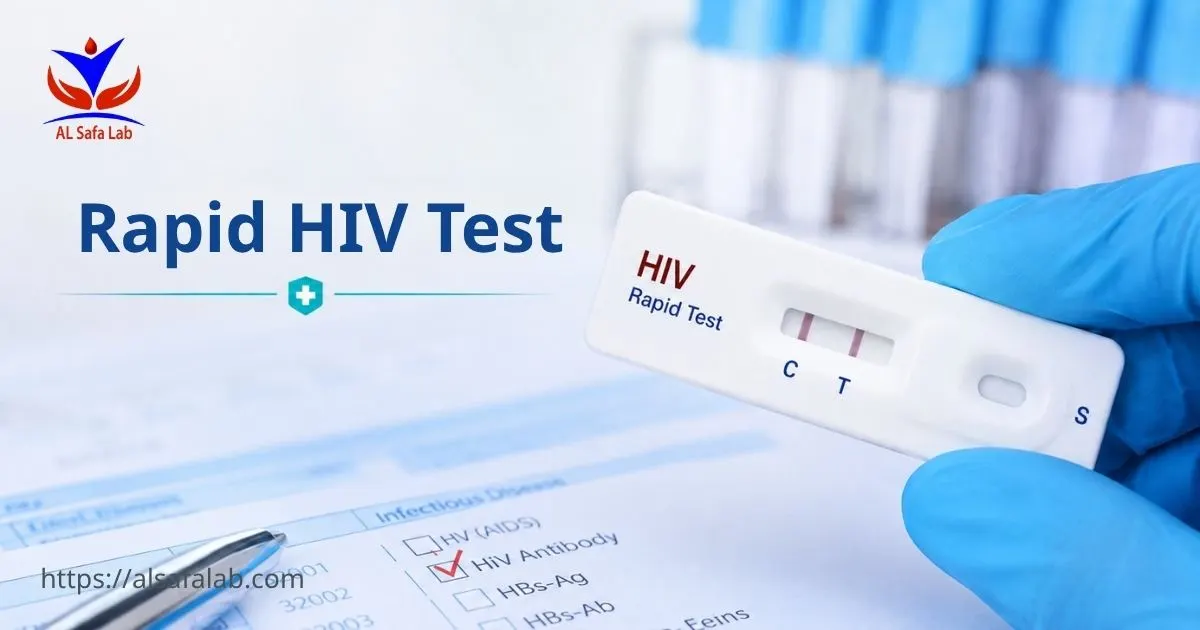
The Rapid HIV Test, also known as the HIV Antibody (AIDS) Test, is a blood test used to detect antibodies produced by the immune system in response to infection with the Human Immunodeficiency Virus (HIV).
Because antibodies take time to develop after infection, this test is most reliable when performed at the appropriate time following possible exposure.
One of the main advantages of the Rapid HIV Test is that results are typically available in less than 30 minutes, making it one of the fastest HIV screening methods available.
When Should You Get a Rapid HIV Test?
Your healthcare provider may recommend a Rapid HIV Test (HIV Antibody AIDS Test) if you have experienced any of the following situations:
- Unprotected sexual intercourse.
- A broken or slipped condom during sex.
- Sexual contact with a partner who has HIV or whose HIV status is unknown.
- Sharing needles or contaminated sharp instruments.
- Occupational exposure, such as an accidental needlestick injury.
- Before marriage.
- Before or during pregnancy.
- Routine sexual health screening.
- After being diagnosed with another sexually transmitted infection (STI).
It is important to remember that HIV infection may not cause symptoms for months or even years, which is why testing is the only reliable way to confirm or rule out infection.
Why Choose a Rapid HIV Antibody Test?
Many people prefer the Rapid HIV Antibody Test (HIV Ab) because it offers several important advantages:
- Results in less than 30 minutes.
- Fast and simple testing procedure.
- No fasting required.
- Available at the laboratory or through home sample collection.
- Complete privacy and confidentiality.
- Helps determine whether additional HIV testing is needed.
Is the Rapid HIV Test Accurate?
Yes. The Rapid HIV Antibody Test is highly accurate when performed after the body has had enough time to produce detectable HIV antibodies.
The accuracy of the test depends on several important factors, including:
- The amount of time since possible HIV exposure.
- The type of HIV test performed.
- The quality of laboratory reagents and equipment.
- Proper sample collection and laboratory procedures.
For this reason, laboratory specialists usually ask about the date of your most recent possible exposure before interpreting the result.
Does a Negative HIV Test Mean You Are Not Infected?
Not necessarily. The answer depends on when the test was performed.
If the test is taken too soon after possible exposure, the body may not yet have produced enough HIV antibodies for the test to detect them. In this situation, the result may be negative even though infection is present.
However, when the Rapid HIV Antibody Test is performed after the appropriate testing interval, a negative result is considered highly reassuring.
This is why choosing the right testing time is just as important as choosing the right HIV test.
What Does a Positive Rapid HIV Test Mean?
A reactive (positive) Rapid HIV Test does not confirm HIV infection by itself.
A reactive screening result must always be followed by confirmatory testing according to current medical guidelines before a final diagnosis is made.
For this reason, treatment should never be started and HIV infection should never be confirmed based on a single rapid screening test alone.
Does the Rapid HIV Test Require Fasting?
No. The Rapid HIV Antibody Test (HIV Ab) does not require fasting and can be performed at any time during the day.
You do not need to avoid eating or drinking before the test. If you are having additional laboratory tests at the same visit, our laboratory specialists will let you know if any special preparation is required.
Can I Get a Rapid HIV Test at Home?
Yes. If you prefer not to visit the laboratory, Al Safa Medical Laboratory offers a Home Visits service.
A trained healthcare professional will collect your blood sample at your home while following strict medical protocols and maintaining the highest standards of privacy and confidentiality.
This service is ideal for people who:
- Prefer to be tested in a private setting.
- Have difficulty visiting the laboratory.
- Value convenience and confidentiality.
How Should I Prepare for a Rapid HIV Test?
The Rapid HIV Test requires very little preparation.
Before your appointment, we recommend that you:
- Inform the laboratory specialist about the date of your most recent possible HIV exposure, if applicable.
- Bring any previous HIV or STI test results if available.
- Answer the medical questions that help determine whether the Rapid HIV Antibody Test is the most appropriate test for your situation.
There is no need to fast, and you should continue taking your regular medications unless your healthcare provider advises otherwise.
Why Choose Al Safa Medical Laboratory for HIV Testing?
When people look for an HIV testing laboratory, they usually care about three things:
- Confidentiality.
- Accuracy.
- Fast results.
At Al Safa Medical Laboratory, we are committed to providing all three while ensuring a professional and comfortable testing experience from booking to result delivery.
Why patients choose us
- Rapid HIV Antibody Test (HIV Ab) with results available in less than 30 minutes.
- Complete privacy and strict confidentiality for all patient information.
- Testing available at the laboratory or through home sample collection.
- Qualified laboratory professionals following modern diagnostic standards.
- Medical services and educational content reviewed by experienced physicians and laboratory specialists.
- Easy appointment booking through our website, WhatsApp, or phone.
Can the Rapid HIV Test Be Combined with Other STI Tests?
Yes. Depending on your medical history, symptoms, or possible exposure, your healthcare provider may recommend additional Sexually Transmitted Infection (STI) tests alongside your HIV screening.
Common tests include:
- Syphilis.
- Gonorrhea.
- Hepatitis B.
- Hepatitis C.
- Chlamydia.
- Herpes Simplex Virus (HSV).
- Trichomoniasis.
For patients who require a more comprehensive evaluation, Al Safa Medical Laboratory also offers an Advanced STD Screening Package, allowing multiple sexually transmitted infections to be assessed without scheduling each test separately.
How Much Does a Rapid HIV Test Cost?
The cost of a Rapid HIV Antibody Test may vary depending on the type of test and periodic service updates.
For the latest pricing information, please contact Al Safa Medical Laboratory through WhatsApp or by phone (01030903637). Our team will provide the current price and answer any questions regarding testing or appointment booking.
How Can I Book a Rapid HIV Test?
Booking your HIV test is quick and easy. You can schedule your appointment by:
- Booking online through our website.
- Contacting our customer support team via WhatsApp.
- Calling our laboratory directly.
- Visiting any Al Safa Medical Laboratory branch (6 Mahdy Arafa St., above Carrefour Market, End of Mostafa El-Nahhas St., Nasr City, Cairo, Egypt)
If you prefer to be tested at home, you can also request our Home Visits service, which provides the same professional standards while maintaining complete privacy.
Are My HIV Test Results Confidential?
Absolutely. At Al Safa Medical Laboratory, patient confidentiality is one of our highest priorities.
All personal information, laboratory records, and HIV test results are handled with strict confidentiality and protected using secure procedures to ensure that medical information is disclosed only to authorized individuals.
Whether you choose laboratory testing or home sample collection, your privacy remains fully protected throughout the entire process.
Frequently Asked Questions
What Is the Maximum Time It Takes for HIV Antibodies to Appear?
Most people develop detectable HIV antibodies within several weeks after infection, although some individuals may take longer. Testing at the appropriate time after exposure helps ensure accurate results.
Which Test Detects HIV?
HIV can be detected using the HIV Antibody Test (HIV Ab), the Fourth-Generation HIV Ag/Ab Test, or the HIV PCR (NAT) test. The best option depends on the timing of possible exposure.
Does a Weak Immune System Mean You Have HIV?
No. A weakened immune system does not necessarily indicate HIV infection. Only an appropriate HIV test can confirm or rule out the infection.
Is an HIV Antibody Test the Same as an AIDS Test?
No. An HIV Antibody Test detects antibodies produced in response to HIV infection. There is no separate laboratory test called an AIDS Test. AIDS is the most advanced stage of HIV infection and is diagnosed after HIV has been confirmed, based on specific clinical and immunological criteria.
What Is the Difference Between an HIV Antibody Test and an HIV PCR Test?
An HIV Antibody Test detects antibodies produced by the immune system after HIV infection, while an HIV PCR Test detects the virus itself by identifying HIV RNA. Antibody testing is commonly used for routine HIV screening, whereas HIV PCR is mainly used in specific clinical situations, including suspected early infection.
Does an HIV Antibody Test Detect AIDS?
No. An HIV Antibody Test detects antibodies to HIV, not AIDS. AIDS is the advanced stage of HIV infection and is diagnosed based on HIV infection together with specific clinical and immunological findings.
Which HIV Test Is Right for Me?
The most appropriate HIV test depends on the timing of possible exposure and your clinical situation. An HIV Antibody Test is commonly used for routine screening, while a Fourth-Generation HIV Ag/Ab Test or an HIV PCR Test may be recommended in certain situations. A healthcare provider can help determine the most appropriate test.
Medical References:
The medical information on this page is based on guidance from internationally recognized healthcare organizations, including:
- World Health Organization (WHO). Rapid HIV Tests: Guidelines for Use in HIV Testing and Counselling Services in Resource-Constrained Settings. Geneva: World Health Organization; 2004.
- Centers for Disease Control and Prevention (CDC) – Getting Tested for HIV
- National Institutes of Health (NIH) – HIV Testing